
What Are We Actually Practicing When We Practice Yoga?
Yoga is more than the shape of a posture. A reflection on Patanjali’s Yoga Sutra, self-observation, and what asana can teach us about the mind.
Beginning with Physical Practice
For many of us, yoga begins with the body. We learn postures, follow sequences, coordinate movement with breath, and become more familiar with what our bodies can do. We may grow stronger, more flexible, better balanced, or more coordinated. A posture that once felt difficult becomes easier to hold, deepen, or breathe through.
These changes are part of practice, and there is nothing wrong with enjoying them. Becoming stronger feels good. Discovering new movements can be exciting, and learning a difficult posture can bring a sense of accomplishment. Physical practice can simply be enjoyable. We do not need to dismiss these benefits in order to explore yoga more deeply.
But after practicing for some time, another question may arise: What exactly am I practicing when I practice yoga?
At first, the answer seems obvious. If I am practicing Warrior II, I am practicing Warrior II. If I am practicing a balance, I am learning to balance. If I am practicing a backbend, I am working with strength, mobility, coordination, and perhaps confidence.
But something else is happening at the same time.
Imagine holding a standing posture. At first, everything feels comfortable. Then your legs begin to tire, your breathing changes, and you wonder when the teacher will tell you to come out.
Perhaps you think this is too long.
You look at the person beside you and notice that they seem completely comfortable. Then another thought appears: Why am I struggling when everyone else looks fine?
Or perhaps you react differently. You decide not to come out no matter what and push harder because stopping feels like failure.
The posture itself may not have changed. Your feet remain in place, your arms extended, and from the outside you still look as though you are practicing Warrior II.
But inside, quite a lot has happened.
There was physical effort, followed by a reaction to that effort: comparison, impatience, determination, fear, or the desire to prove something.
Learning to Observe
And then there is another possibility.
You notice it.
You notice that your legs are tired, your breathing has changed, and the thought I want to stop has appeared. You notice yourself looking at someone else and recognize the comparison that follows.
This does not mean analysing every thought during practice. It means recognizing that there may be more to observe than the physical shape of the posture.
That changes the question.
Instead of asking only, “Can I do this posture?”, we can also ask, “What am I noticing while I am here?”
A posture becomes more than something to achieve. It becomes a situation in which we can observe ourselves.
Sometimes what we notice is physical. One side may move differently from the other. Changing the position of a foot may affect the hip. We may lose balance when attention wanders, or discover that breathing becomes more difficult as effort increases.
These observations help us understand the body.
But we may also notice how quickly we become frustrated, how strongly we want to go further, which movements we avoid, or how often we compare ourselves with others without realizing it.
Our experience also changes from day to day. A posture that felt easy yesterday may feel difficult today. Something that once made us anxious may gradually become familiar. Sometimes we have patience; sometimes we do not.
The posture gives us a consistent situation, but we are not exactly the same person entering it every time.
This is one reason repetition can remain interesting. We may practice the same posture hundreds of times, but the experience need not be identical. If our only goal is to reproduce the shape, repetition can feel monotonous. If we also observe what happens while we practice, each repetition offers another opportunity to notice.
Becoming interested in observation does not make physical practice unimportant. Strength, mobility, balance, and coordination matter. The body adapts to what we repeatedly ask it to do, and increasing physical capacity can make movement easier and more enjoyable.
Sometimes the lesson of a posture is simply physical: we need more strength, another movement option, or better coordination.
There is no need to turn every physical experience into a philosophical lesson. The point is only that the physical experience does not have to be the only thing we are practicing.
Yoga Philosophy and the Activity of the Mind
This becomes especially clear in Patañjali’s Yoga Sūtra. In its second aphorism, he writes:
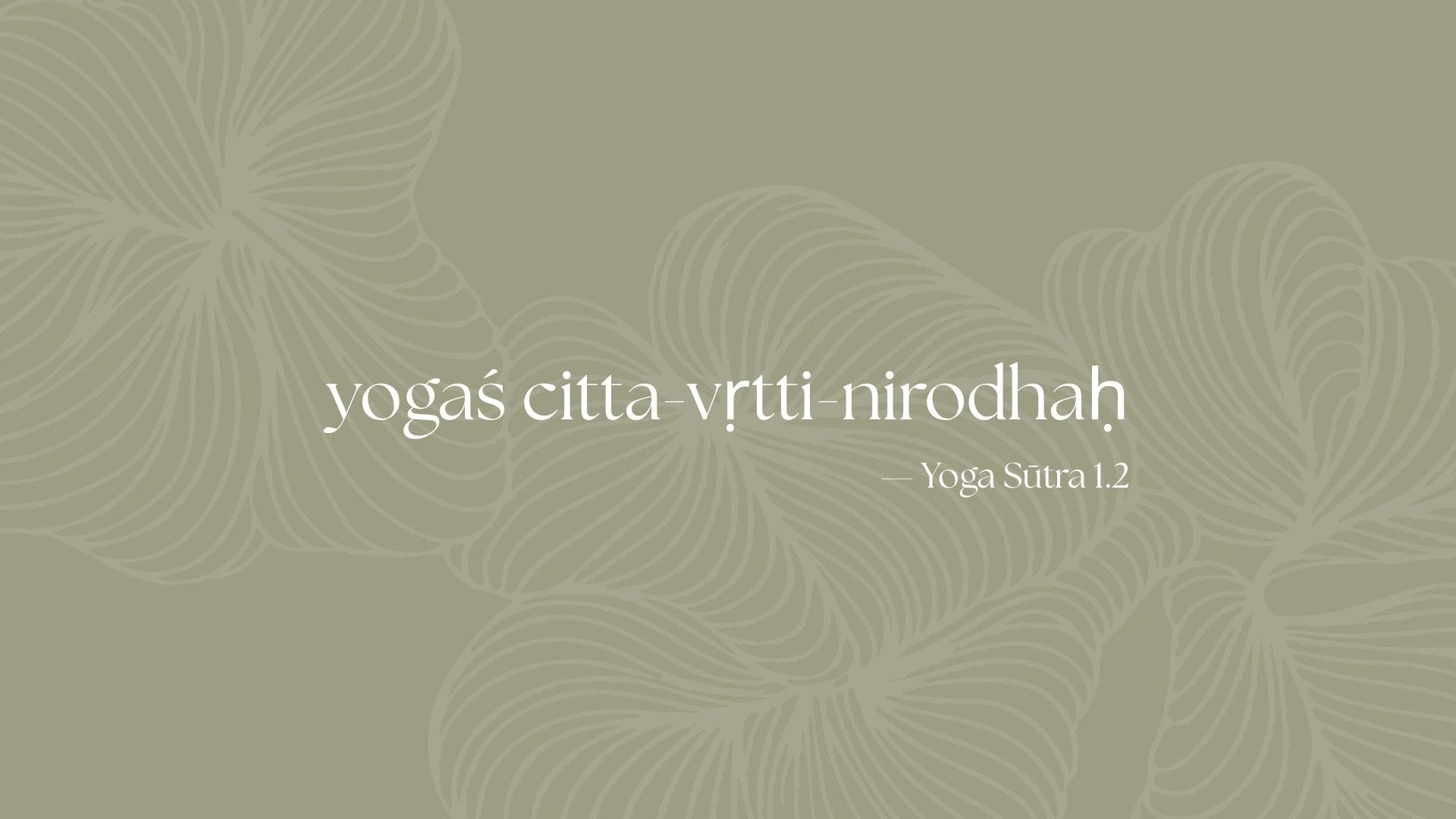
The statement directs our attention to the activity of the mind: the movements, reactions, and patterns that arise in experience. During asana practice, these become visible in ordinary moments—when discomfort produces resistance, comparison appears, a thought such as I can’t do this is believed, or attention wanders and we later realize it has gone.
Asana gives us a concrete setting in which to observe mental activity. We are not only shaping the body; we are also learning to recognize what the mind is doing while the body is in the posture. Rather than automatically following every thought or reaction, we begin to notice it as it arises.
The three central terms—citta, vṛtti, and nirodha—have been translated and interpreted in different ways, and each deserves more attention than we can give it here. We will study them separately in later chapters.
Imagine again that difficult posture.
The thought that I can’t do this appears. Do we immediately believe it?
The thought I should be better at this appears. Do we notice the expectation inside it?
A sensation arises and we dislike it. Can we distinguish the sensation from our reaction to it?
We become distracted. At what point do we realize that our attention has moved elsewhere?
These moments are small and usually invisible to others. They do not make the posture look more impressive, but they may tell us something about ourselves.
This is where the visible and invisible parts of practice meet.
The visible practice involves foot placement, spinal organization, breathing, range of motion, and strength. The less visible practice involves noticing impatience, recognizing comparison, observing attention, and becoming aware of habitual responses to difficulty.
Both can happen at once. We do not have to choose between practicing the body and observing the mind. The body may provide a practical environment in which to begin.
This also brings philosophy out of the abstract. It is easy to talk about awareness when comfortable. It may be more revealing to notice what happens when our legs are tired, we lose balance, or a posture does not unfold as expected.
Applying Observation in Practice
This is where practice can become an investigation.
Instead of approaching every posture with How far can I go?, we might ask, What happens if I change this?
Instead of deciding immediately that one version is better, we can notice how different versions feel. Instead of judging ourselves for losing balance, we can become interested in what happened just before it. Instead of treating difficulty as evidence that we are bad at yoga, we can ask what difficulty reveals.
The quality of the question changes the quality of the practice.
Perhaps this is why yoga can remain interesting after many years. There is always another posture to learn, movement to explore, or physical capacity to develop. There is also an ongoing opportunity to observe how we meet those experiences.
Some days we meet them with curiosity, some with ambition, resistance, or patience.
The practice does not require us to pretend these reactions are absent. It gives us an opportunity to notice them.
We do not need to begin our study of yoga by finding the perfect definition of what yoga is. We can begin closer to our actual experience.
The next time you practice, notice the body, breath, effort, and available movement. Then occasionally notice something else.
Where does your attention go?
What happens when something becomes difficult or when you cannot do what you expected?
Do you push harder, withdraw, compare, or judge?
And when any of these reactions arise, can you notice them?
The posture may be what brings us into practice. But what we learn to observe while we are there may take us somewhere much deeper.
Instead of asking only:
“Can I do this posture?”
we can also ask:
“What is this practice teaching me to notice?”
Whether you are new to yoga or continuing an established practice,

we offers a welcoming space to explore movement, breath, and awareness.