
Satya Beyond the Mat: Truthfulness in Bangkok’s Yoga Community
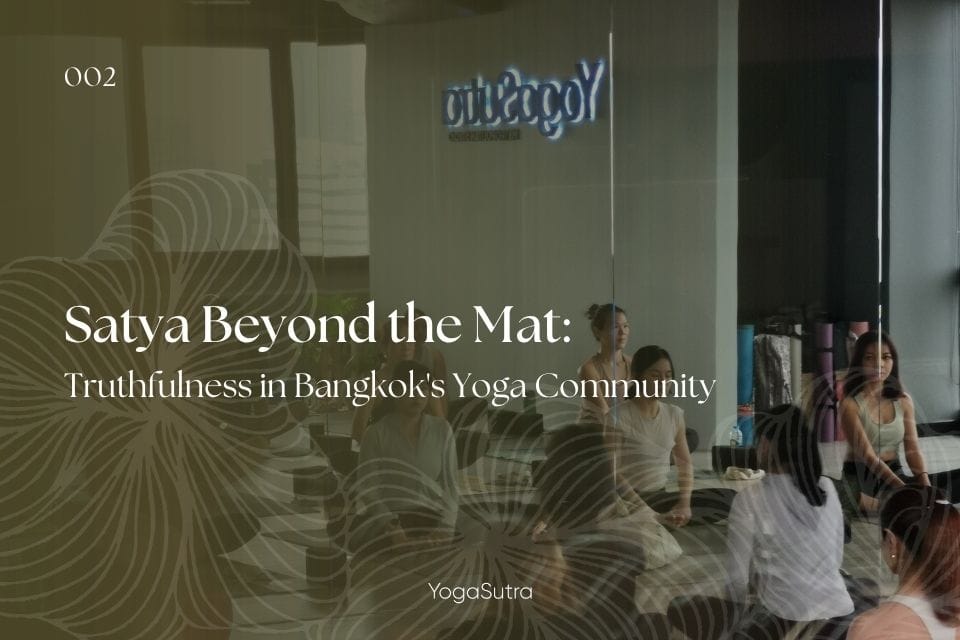
Yoga teaches truthfulness on the mat. Does it extend to how studios employ foreign teachers in Thailand? A reflection on Satya and fairness in Bangkok’s yoga community.
Yoga studios speak often about values.
We teach students to practice awareness, compassion, non-harming and truthfulness. We quote the Yoga Sutras. We speak about taking yoga beyond the physical practice and carrying its principles into everyday life.
But perhaps one of the more uncomfortable questions for the modern yoga community is this:
Do the businesses teaching yoga live according to the principles they ask their students to practice?
In Bangkok, this question deserves consideration, particularly when it comes to the employment of foreign yoga teachers.
Satya Is More Than Telling the Truth
Satya, commonly translated as truthfulness, is the second of Patanjali’s five yamas.
At the simplest level, Satya means not lying. But as a practice, it asks considerably more of us. It asks whether our words, choices and actions are aligned.
For a yoga teacher, this may mean teaching within the limits of one’s knowledge rather than pretending to know more than one does.
For a student, it may mean honestly recognising the condition of the body rather than forcing a posture for the sake of appearance.
And for a yoga studio, Satya should extend into the way the business itself operates.
A studio cannot meaningfully speak about yogic ethics in the practice room while treating those ethics as optional once we enter the office.
There Is a Cost to Employing Foreign Teachers Properly
Thailand regulates the employment of foreign workers. A foreign teacher’s ability to work is not simply a matter of a studio inviting someone to teach a class.
Employers and foreign workers have legal responsibilities concerning permission to work, the employer, the nature of the work and, where applicable, the workplace.
The Thai Ministry of Labour states that an employer should employ a foreign worker who is authorized to work for that employer and should not employ someone without the appropriate permission or outside the conditions under which that person is permitted to work. Ministry guidance also states that changes or additions concerning work, workplace or employer require the appropriate process and authorization.
For legitimate businesses, compliance has a real cost.
There is administration. There are documents. There may be visa and work-permit processes, professional fees, accounting requirements, company requirements, tax and social-security obligations, and considerable staff time involved in maintaining compliance.
A studio that undertakes these responsibilities is making an investment in employing its foreign teachers properly.
This is where the question becomes larger than immigration paperwork.
It becomes a question of fairness.
When One Studio Carries the Cost and Another Takes the Benefit
Imagine that Studio A spends the time and money necessary to employ a foreign teacher properly.
It builds its company structure appropriately. It prepares documentation. It pays professional and administrative costs. It assumes the responsibilities associated with being that person’s employer.
Then Studio B invites the same teacher to teach classes without undertaking equivalent responsibilities or ensuring that the teacher is legally authorized to work for Studio B.
Studio B can consequently access the benefit of an international teacher without carrying the same cost or responsibility as Studio A.
This is not simply competition.
Competition would mean two studios playing according to the same rules and trying to create the better offering.
One studio may have better teachers. Another may have better programming. One may charge less. Another may provide better facilities.
That is healthy competition.
But avoiding responsibilities that another business has paid to fulfil creates an uneven playing field.
And within a yoga community, there is another layer to consider.
It is difficult to teach Satya while benefiting from an arrangement we would prefer not to examine too closely.
Teachers Also Carry Responsibility
It would be too convenient to place the entire responsibility on studio owners.
Foreign teachers have agency too.
A teacher should understand the conditions under which they are permitted to work in Thailand and whether accepting classes from another studio requires changes or additional authorization.
Being offered a class does not automatically make accepting it appropriate.
Likewise, saying, “Everyone does it,” does not transform a questionable practice into an ethical one.
Yoga asks us repeatedly to examine habitual behaviour rather than justify it because it has become normal.
Teachers should therefore be willing to ask:
Am I legally permitted to teach here?
Does my current employment arrangement allow this?
Is another organisation carrying the legal and financial responsibility that enables me to live and work in Thailand while I offer my services elsewhere?
These may be uncomfortable questions….. Satya is not necessarily comfortable.
This Is Not About Owning Teachers
There is an important distinction.
A studio does not own a teacher simply because it sponsors, employs or regularly works with that person.
Teachers are professionals. They should be free to develop their careers, negotiate their employment and move between organisations when they wish, subject to their contracts and the law.
Nor should “loyalty” become an excuse for studios to control teachers or prevent legitimate competition.
That would be another ethical problem.
The issue is not whether teachers should ever teach at multiple studios.
The issue is whether each working relationship is transparent, lawful and fair.
If a teacher wishes to work for several organisations and the necessary permissions allow it, there is nothing inherently contrary to yogic ethics about doing so.
Transparency changes the situation entirely.
A Yoga Community Should Have Higher Standards, Not Lower Ones
Yoga businesses are still businesses.
They have rent, salaries, taxes, marketing expenses and commercial pressures. Studios compete for students and teachers. They need revenue to survive.
We should not romanticise the yoga industry as though money and competition disappear simply because the product happens to be yoga.
But perhaps the opposite should be true.
If we choose to build businesses around a philosophical tradition concerned with ethical conduct, awareness and responsibility, then we should be particularly willing to examine how we conduct those businesses.
Ahimsa should influence how we treat employees.
Asteya—non-stealing—should make us examine what benefits we take without fairly contributing toward them.
Aparigraha should make us question unnecessary possessiveness.
And Satya should require honesty about how our businesses actually operate.
These principles should not stop at the studio door.
Satya When Nobody Is Watching
It is easy to practise truthfulness when truthfulness costs nothing.
The more meaningful test comes when doing things properly is slower, more expensive or less convenient.
Compliance costs money.
Ethical employment can be inconvenient.
Respecting another business’s investment may occasionally mean saying no to an opportunity.
But yoga was never a philosophy built around doing whatever is most convenient.
If Bangkok wants a healthy and sustainable yoga community, studios do not need to stop competing. Quite the opposite. Strong competition can improve teaching, programming and professionalism across the industry.
But we should compete through the quality of what we create—not through avoiding responsibilities that others have chosen to carry.
Studios should ask whether foreign teachers are properly authorized before putting them on the schedule.
Teachers should understand the conditions under which they are working.
Studio owners should communicate openly with one another rather than quietly benefiting from arrangements they know may be problematic.
And all of us who make a living from yoga should occasionally ask whether the philosophy displayed on our walls is also visible in our business decisions.
Because ultimately, Satya is not what we say we believe.
It is the degree to which our actions remain consistent with those beliefs when truthfulness has a cost.
Yoga does not end when we roll up the mat.
For those of us who teach it, employ people through it and build businesses around it, that may be precisely where the practice of yoga begins.
Whether you are new to yoga or continuing an established practice,

we offers a welcoming space to explore movement, breath, and awareness.